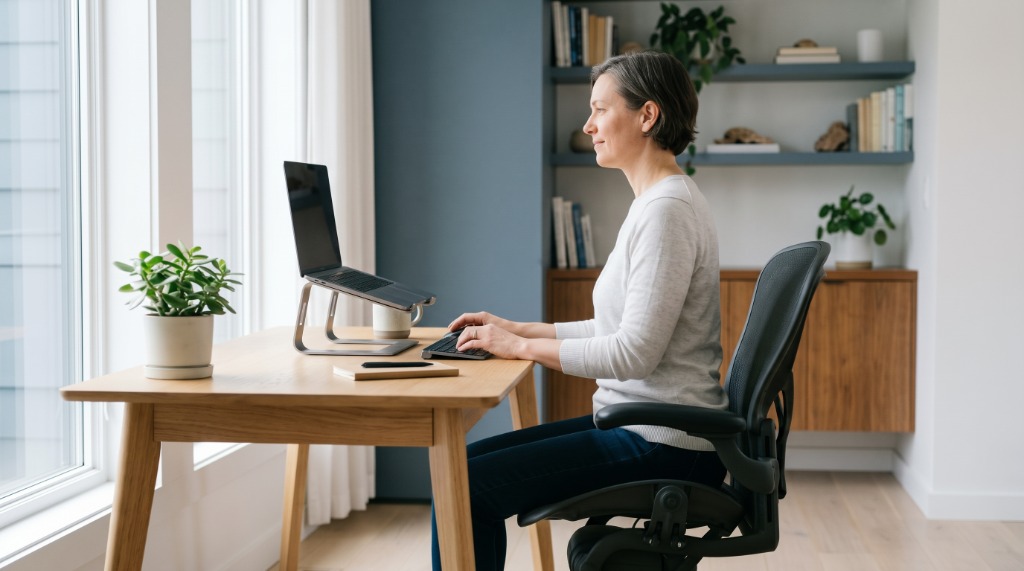
You can buy a better chair, raise your screen, and stack your desk with ergonomic upgrades - then still end the day with a locked-up lower back, tight hips, numb legs, and a brain that feels half-charged. That is why learning how to reduce sitting related pain starts with a hard truth: the problem is rarely just the chair. Sitting exposes weakness in your body’s control system. It does not create the whole problem by itself.
For remote workers, expats, and digital nomads, this matters more than ever. You are not just sitting at one desk in one controlled environment. You are working from apartments, airport lounges, coworking spaces, rideshares, and kitchen counters. If your strategy depends on perfect setup every time, it will fail. You need a body that can regulate pressure, movement, circulation, and muscular tension under less-than-perfect conditions.
Why sitting pain keeps coming back
Most advice treats sitting pain like a simple mechanics issue. Sit taller. Pull your shoulders back. Engage your core. Stand every 30 minutes. That advice is not useless, but it is incomplete. If the deeper coordination systems are already strained, your body will drift back into the same pain pattern even after you correct your posture.
This is the part most people miss. Your body is constantly managing tone, joint position, breathing rhythm, blood flow, and neurological signaling. When one area loses efficient control, another area compensates. That is why pain from sitting rarely stays in one place. It moves from neck to shoulders, from low back to hips, from hip tension to poor sleep, from poor sleep to fatigue and brain fog.
The real question is not just, "What chair are you using?" It is, "Which system is losing control when you sit still for too long?"
How to reduce sitting related pain without guessing
If you want real progress, stop chasing random fixes and start identifying the pattern. Sitting pain usually shows up in clusters. One person gets upper back tension and headaches. Another gets low back compression and hip tightness. Another feels restless legs, shallow breathing, fatigue, and irritability by mid-afternoon.
These are not identical problems, so they should not get identical solutions.
A precision approach looks at where your body is failing to adapt. In the Zone System model, symptoms are organized through six Biological Zones that reflect different control patterns in the body. That matters because the same sitting habit can trigger very different responses depending on which zone is under stress. One person may need more spinal mobility and breathing restoration. Another may need circulation support and lower-body activation. Another may be dealing with a tension pattern that starts higher up and pulls the whole frame out of balance.
This is why generic posture advice often feels temporary. It gives you a surface correction without telling you why your system keeps defaulting back to the same strain.
Start with the symptom pattern, not the furniture
Before you change your setup again, pay attention to what happens after 60 to 90 minutes of sitting. Does your low back ache first, or do your shoulders climb toward your ears? Do your hips feel glued down when you stand up? Do you get sleepy after lunch even when your workload is light? Does sitting create agitation instead of calm?
Those details matter. They tell you whether your issue is mostly compression, muscular guarding, circulation slowdown, breathing restriction, or a broader neurological imbalance.
A laptop worker with hip pain and stiff hamstrings may think they need more stretching. Maybe they do. But if the deeper issue is poor control through the pelvis and lower spine, stretching alone can make them feel looser for an hour and weaker by evening. On the other hand, someone with chest tightness, neck tension, and poor focus may blame stress when the real issue is that sitting has collapsed their breathing mechanics all day.
The fix has to match the pattern.
The fastest changes that actually help
You do not need a three-hour mobility routine. You need targeted resets that interrupt the specific stress pattern sitting creates in your body.
First, change position more often than you think you need to. Not because movement is magic, but because static load is the problem. Even perfect posture becomes a bad posture when you hold it too long. A 60-second reset every 30 to 45 minutes is more useful than one heroic workout after ten hours of compression.
Second, restore breathing mechanics. A lot of sitting pain is pressure-management failure. When your ribs stay locked, your shoulders tense, your neck overworks, and your lower back takes on stability it was never meant to hold alone. Slow nasal breathing, full rib expansion, and deliberate exhalation can reduce muscular guarding fast. This sounds simple because it is simple. It is also ignored because people want gadgets, not fundamentals.
Third, wake up the areas that go offline during long sitting blocks. Glutes, mid-back stabilizers, and deep abdominal control are common weak links. But this is where nuance matters. If you only strengthen without first reducing the tension pattern that is shutting those areas down, you can reinforce compensation instead of fixing it.
Fourth, stop treating pain as a local issue only. A stiff neck is not always a neck problem. Low back pain is not always a low back problem. Numbness in the legs is not always about the legs. Sitting reveals chain reactions. If you only rub the painful spot, you will miss the command center driving it.
What most desk workers get wrong
They wait for pain to become severe before responding. By then, the body has already rehearsed the dysfunctional pattern hundreds of times.
They also confuse tolerance with health. Just because you can sit for eight hours does not mean your body is handling it well. If you need caffeine to focus, a walk to stop the ache, and a full evening to decompress from tension you built all day, your system is not adapting well. It is surviving.
Another mistake is overcorrecting with intensity. People go from sedentary all day to crushing a workout at night, hoping to cancel out the damage. Sometimes that helps. Sometimes it adds more stress to a body that already lacks coordination and recovery. If your sleep is off, your pain migrates, and your energy drops with prolonged sitting, the issue is probably bigger than deconditioning alone.
A better framework for reducing sitting pain
If you want to know how to reduce sitting related pain in a way that lasts, think in this order: identify the pattern, reduce the trigger, restore control, then build tolerance.
Identify the pattern means noticing where the breakdown begins. Reduce the trigger means changing sitting duration, position, and pressure before symptoms spike. Restore control means using precise corrective work for the zone or pattern involved. Build tolerance means gradually improving your body’s ability to sit, travel, work, and recover without falling apart.
That order matters. Build tolerance too early and you train dysfunction. Chase pain relief only and you stay dependent on temporary fixes. But when you restore the body’s control system first, sitting becomes less costly.
For many people, this is the turning point. They stop obsessing over external setup and start understanding internal response. That is when progress gets faster, because the plan finally matches the problem.
When sitting pain is not just sitting pain
Recurring pain with fatigue, poor sleep, digestive disruption, or brain fog should raise your suspicion. Those symptoms often travel together because the same underlying imbalance is affecting more than one output. Your body is one system, not a collection of disconnected complaints.
That is the blind spot in mainstream desk advice. It acts like your hip pain, mental fog, and shallow sleep are separate issues with separate hacks. Often they are linked. The body loses control in one area, then compensation spreads.
This is where assessment beats guessing. A structured symptom audit can reveal whether your main issue is truly mechanical, or whether sitting is just the daily trigger that exposes a broader imbalance. The Zone System Health Portal is built around that idea - identify the dominant zone pattern first, then apply the right corrective strategy instead of playing wellness roulette.
What to do next if you are tired of trial and error
Start by tracking your symptom sequence for three days. Notice what appears first, what gets worse with sitting, and what lingers after you stop. That gives you more useful data than another impulse purchase.
Then simplify your response. Add short movement resets. Rebuild breathing mechanics. Use targeted corrective exercises based on your actual symptom pattern, not whatever clip is trending. If your pain keeps cycling with fatigue, poor sleep, or foggy focus, stop assuming it is just posture.
You do not need more random tips. You need a body that can sit, move, travel, and work without constant backlash. Once you see sitting pain as a signal instead of a standalone problem, better decisions get a lot easier.
Educational Disclaimer: This article is authored by Dr. Chris Bowe, D.C. for educational and biomechanical wellness purposes only. It is not intended as medical advice or formal surgical diagnosis. Always consult a licensed healthcare practitioner regarding persistent pain or health conditions.
Dr. Chris Bowe, D.C.
Licensed DCDoctor of Chiropractic • Founder of DeskReliefNow
Dr. Chris Bowe is a licensed Doctor of Chiropractic with over two decades of clinical experience in spinal biomechanics, neurophysiology, and posture correction for remote professionals.