You can buy a better chair, raise your screen, and stack two yoga blocks under your laptop - and still end the day with a tight neck, an aching low back, heavy legs, and a brain that feels half a step behind. That is exactly why corrective exercises for desk workers need to go beyond posture tips. If your body keeps slipping back into pain, stiffness, fatigue, or fog, the real issue is usually not the desk. It is the control system running the body under stress.
Most desk advice stops at mechanics. Sit taller. Pull your shoulders back. Stretch your hips. Some of that helps, briefly. But if your nervous system is driving imbalance through one or more body zones, the same pain patterns keep returning. That is why one person feels it in the neck and jaw, another in the mid-back and digestion, and another in the low back with poor sleep and low energy. Same laptop. Different pattern.
Why desk workers stay stuck
Remote work looks free from the outside. In reality, it often means long static sitting, travel fatigue, poor recovery, irregular meals, and constant mental load. That combination pushes the body into compensation. Then the compensation becomes your new normal.
This is where generic mobility routines fail. They treat the symptom location as the cause. Tight hip flexors are not always the primary problem. Rounded shoulders are not always a shoulder problem. A locked-up mid-back may be part of a deeper imbalance affecting breathing, circulation, digestion, or stress output. If the body loses internal coordination, your muscles start doing emergency work they were never meant to do all day.
That is the big shift. You do not need more random stretches. You need the right stimulus in the right area, in the right order.
What corrective exercises for desk workers should actually do
Good corrective work is not about chasing tension. It is about restoring control. That means helping the body reestablish better motion, better pressure handling, and better communication between zones.
For desk workers, the highest-value exercises usually do three things. They reduce the constant forward-pulled pattern created by screens and sitting. They improve how the rib cage, spine, and pelvis coordinate. And they calm the overload pattern that leaves you wired, tired, and physically compressed.
If an exercise leaves you feeling more centered, breathing easier, and standing taller without forcing it, that is usually a good sign. If it only creates a hard stretch sensation but your body snaps back an hour later, you probably treated the symptom and missed the driver.
The 5 best corrective exercises for desk workers
These are not flashy. They are effective because they target the patterns desk workers repeat every day. Do them slowly. Precision beats intensity here.
1. Chin glide with relaxed ribs
Sit or stand tall without arching your low back. Keep your eyes level and gently glide your head straight back, as if making a double chin. Hold for two seconds, then release. Repeat for 8 to 10 reps.
This helps reverse the forward-head pattern without forcing the neck into strain. The mistake is lifting the chin or tightening the low back to fake better posture. Keep the ribs relaxed and let the neck reposition cleanly.
If you get headaches, jaw tension, or upper trap tightness after laptop work, this is often a better starting point than aggressive neck stretching.
2. Wall-supported reach and breathe
Stand with your back against a wall, knees soft, feet a few inches away. Let your low ribs settle down instead of flaring up. Reach both arms forward at shoulder height and take five slow breaths into your upper back and sides.
This looks simple because it is. It also works. Many desk workers are stuck in a chest-up, rib-flared pattern that makes the neck and low back work overtime. This drill helps reposition the trunk so breathing and shoulder motion improve together.
If your shoulders always feel tight, but stretching them never solves it, this is why.
3. Seated pelvic reset
Sit near the front edge of a chair with feet flat. Slowly rock the pelvis forward and backward a few times, then stop in the middle where the sit bones feel even and the spine feels stacked, not rigid. From there, take five slow breaths without lifting the chest.
Desk workers often live at one extreme - either collapsed into the tailbone or overarched in a forced upright posture. Neither is stable. This drill teaches neutral control, which matters because the pelvis influences the spine above it and the hips below it.
If your low back gets tired just from sitting, this is a useful daily reset.
4. Hip flexor unload with glute activation
Kneel in a half-lunge position with one knee down and one foot forward. Gently tuck the pelvis under, squeeze the glute on the kneeling side, and shift forward slightly until you feel the front of the hip open. Hold for 20 seconds, then repeat 3 times per side.
The key is the glute squeeze. Without it, most people just dump into the low back and call it a stretch. This exercise works better because it changes the relationship between the front and back of the hip.
If sitting leaves you with a pinchy front hip, a dragging stride, or low-back compression when standing up, this is one to keep.
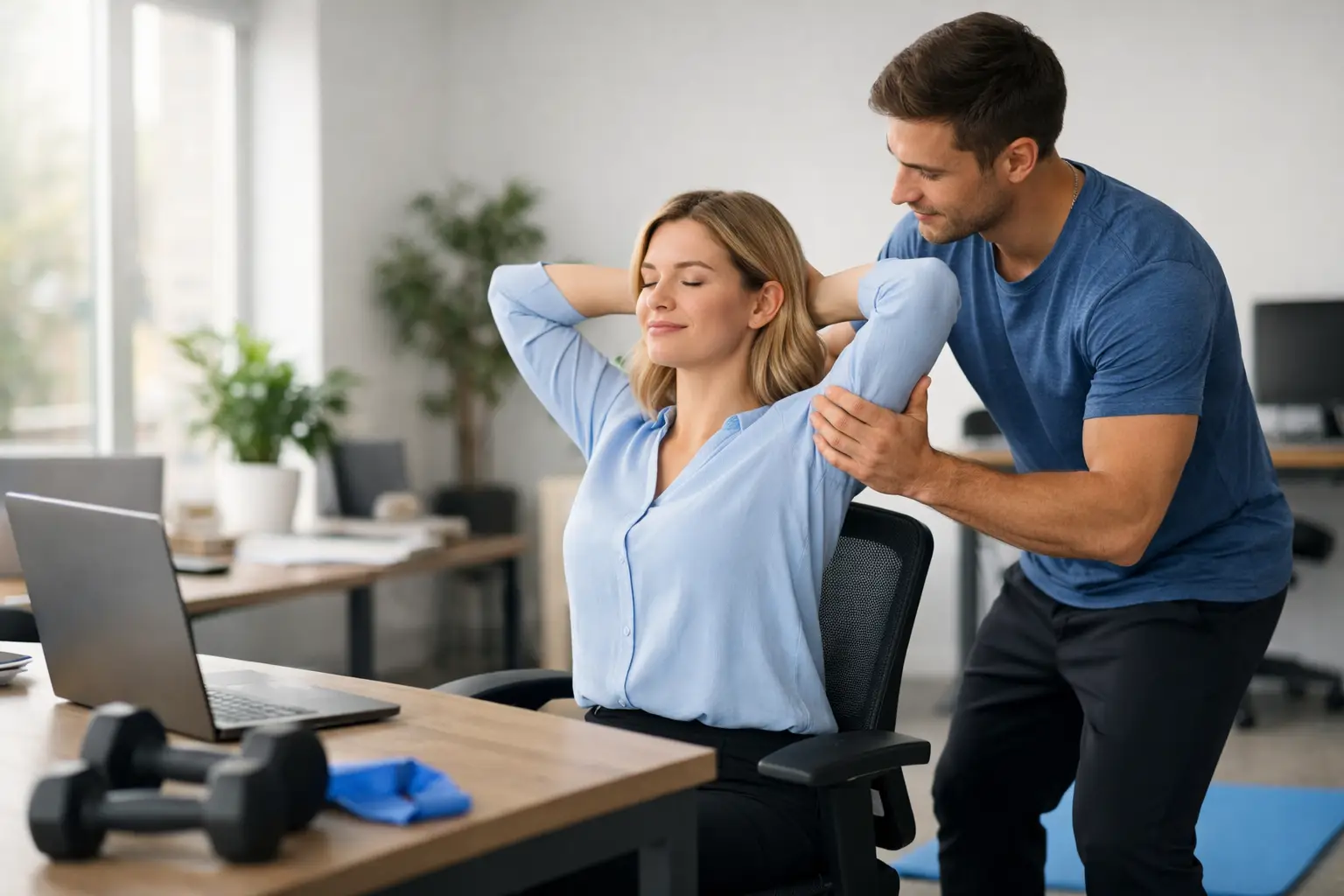
5. Thoracic extension over a chair back
Sit in a chair with a firm upper back support around shoulder blade level. Place your hands behind your head, gently lean your upper back over the chair, and take three slow breaths. Come back up and repeat 5 times.
This can restore motion to a mid-back that has been stuck in flexion all day. That matters more than people realize. When the thoracic spine gets rigid, the neck and low back often pay the price.
If you feel mentally drained after hours at a screen, mid-back restriction may be part of the pattern. Better rib and thoracic motion often changes breathing, focus, and tension faster than another hamstring stretch ever will.
How to use these exercises without wasting time
Do not treat this like a 45-minute workout. That is one reason people quit. For most desk workers, two short rounds per day work better than one long session they never repeat.
Try one round in the first half of your workday and another near the end. Five to ten minutes is enough if you stay consistent. The goal is not to crush the body. The goal is to interrupt the pattern before it hardens.
Also, do not assume more is better. If you are already depleted from travel, poor sleep, or high stress, aggressive mobility can backfire. The right corrective input should leave you clearer and more stable, not wiped out.
When posture is not the real problem
This is where most advice gets shallow. If you keep needing the same fixes, the body may be signaling a deeper zone imbalance. Your pain pattern might be mechanical on the surface but neurological or systemic underneath.
For example, upper body tension may track with a stress-loaded control pattern. Midsection tightness may show up alongside digestive inconsistency. Low-back fatigue may travel with poor sleep, sluggish recovery, or a drained, overstimulated state. Those combinations matter. They tell you the body is not just misaligned. It is mismanaged internally.
That is why a desk worker in Lisbon, Austin, or Medellin can have a perfect remote setup and still feel terrible. Better equipment helps. But it cannot correct a body that has lost proper coordination across its zones.
How to know if your corrective plan is too generic
If your routine was pulled from a random mobility video and gives every body the same drills, it is generic. If it ignores your symptoms outside the pain area, it is generic. If it never asks about sleep, digestion, energy, tension patterns, or focus, it is generic.
Precision changes everything. The right corrective strategy depends on what else is happening in your system. A stiff neck with shallow breathing is not the same as a stiff neck with bloating and fatigue. The exercise list may overlap, but the priority and sequence should not.
That is why assessment matters. Before you chase another foam roller routine, identify the dominant pattern first. The Zone System Health Portal is built around that exact idea: stop guessing, map the imbalance, then apply corrective work with a reason behind it.
What results to expect
You may feel early changes in tension, breathing, and sitting comfort within a few sessions. Pain that has been repeating for months usually takes longer, especially if travel, stress, and inconsistent recovery are part of your routine.
The bigger marker is this: your body starts holding a better position without force. You stop fighting to sit upright. You stand up from work with less stiffness. Sleep gets less fragmented. Focus comes back faster. That is what useful corrective work looks like.
If your body keeps asking for relief, do not keep throwing generic fixes at a specific problem. The smarter move is to find the pattern first, then match the exercise to the imbalance. That is how you get out of the loop and get your body working with you again.
Educational Disclaimer: This article is authored by Dr. Chris Bowe, D.C. for educational and biomechanical wellness purposes only. It is not intended as medical advice or formal surgical diagnosis. Always consult a licensed healthcare practitioner regarding persistent pain or health conditions.
Dr. Chris Bowe, D.C.
Licensed DCDoctor of Chiropractic • Founder of DeskReliefNow
Dr. Chris Bowe is a licensed Doctor of Chiropractic with over two decades of clinical experience in spinal biomechanics, neurophysiology, and posture correction for remote professionals.